
The Wire Around the Rod
For years I have carried a picture in my mind of what Christian marriage was meant to become.
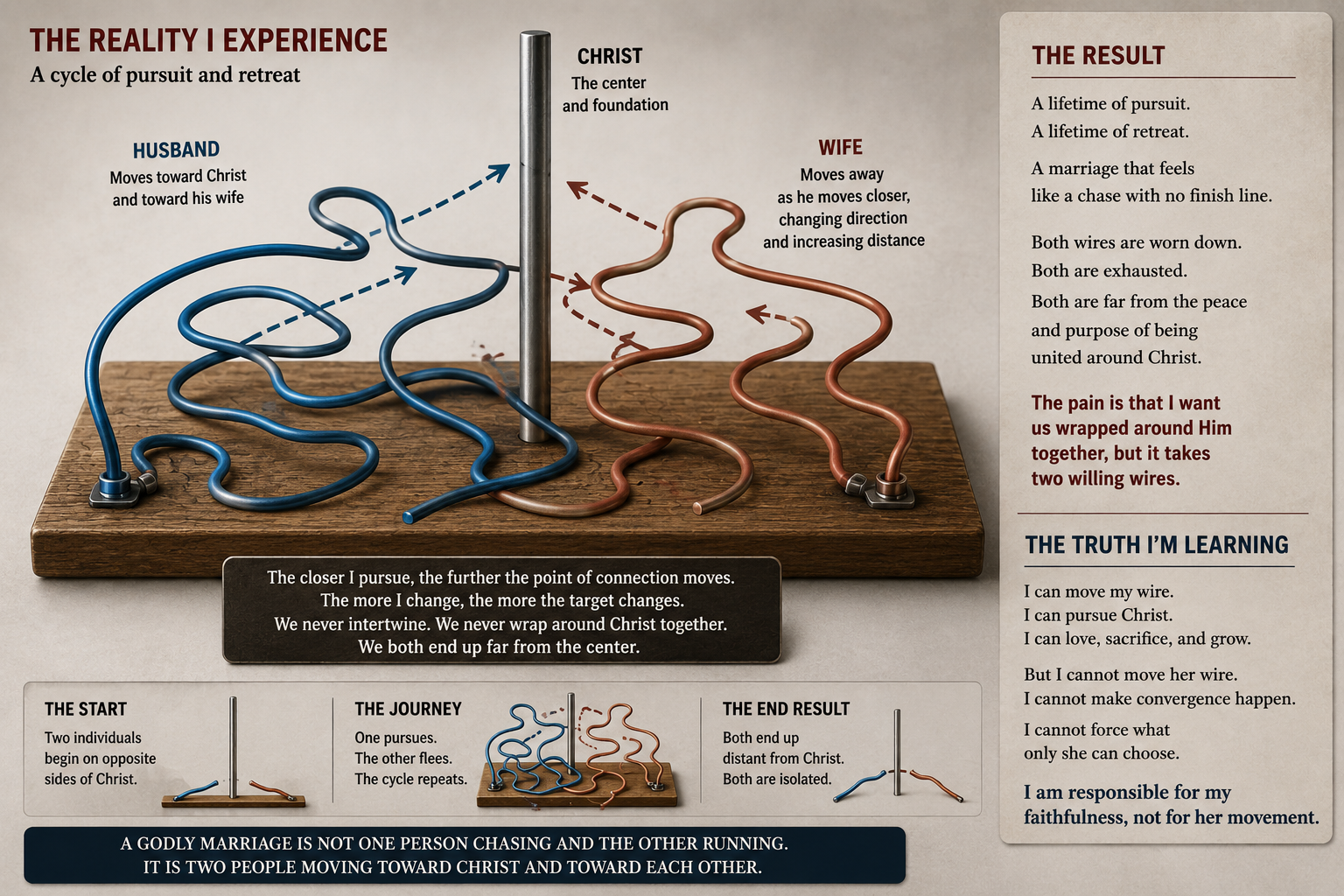
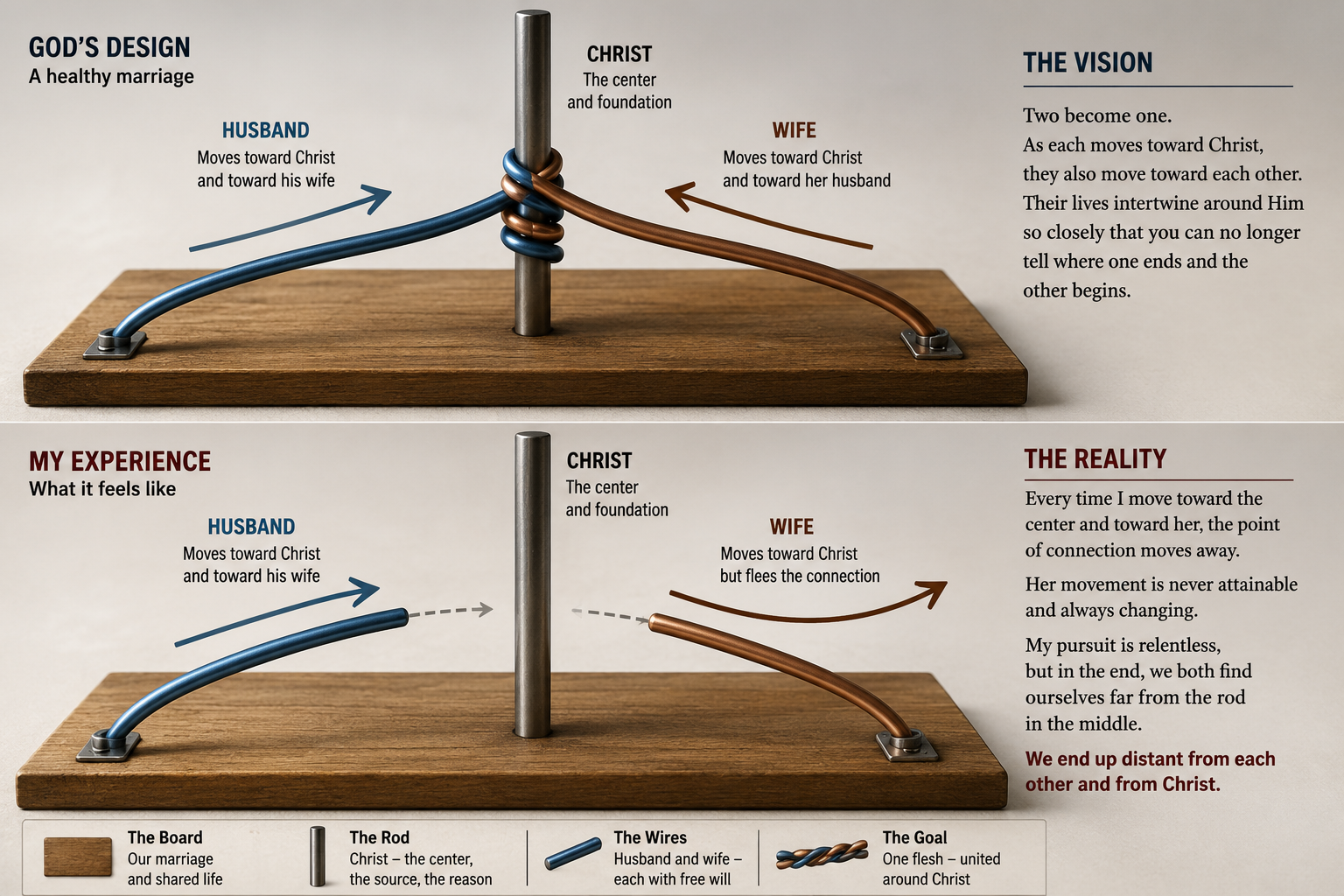
Imagine a wooden board with a steel rod standing vertically in the center. That rod represents Christ. On opposite sides of the rod are two pieces of wire, each anchored firmly to the same foundation. As each wire bends toward Christ, they also bend toward one another. Eventually they wrap themselves around the rod so tightly that it becomes difficult to distinguish where one wire ends and the other begins. You can still see that they began on opposite sides, but they have become so intertwined around Christ that they are now one.
That has always been my picture of Genesis 2:24. Two becoming one flesh by both pursuing Christ.
Unfortunately, that has not been my experience.
Instead, my experience has felt very different. Every time I bend my wire toward the center, the other wire seems to bend just enough to keep us from ever truly intertwining. Every difficult conversation moves the point of connection. Every sacrifice seems to uncover another expectation. Every improvement reveals another deficiency. The destination always appears just beyond my reach. Instead of wrapping together around Christ, our paths become a tangled maze across the board as one continues pursuing while the other continues pulling away.
For most of my life, I believed the answer was obvious. If something wasn’t working, I simply needed to become a better man.
Work harder.
Love better.
Provide more.
Sacrifice more.
Communicate better.
Become more.
Eventually, if I did enough, I would become enough.
That belief didn’t come from nowhere. I have very few memories of simply being valued because I was me. Throughout much of my life, my value seemed connected to what I could accomplish, fix, provide, protect, or carry. Without realizing it, I brought that same belief into marriage.
I also don’t believe that love has to exist in its fullest form on a wedding day. History is full of marriages—including arranged marriages—that grew into deep affection, admiration, friendship, and genuine love over time. Love can grow as two people truly come to know one another.
What I have been forced to wrestle with is something entirely different.
More than two years into my marriage, after my wife has seen the real man—not the version she may have imagined, but the man with his strengths, weaknesses, quirks, habits, failures, convictions, and personality—I find myself asking a question I never expected to ask.
Is her heart moving toward loving that man more deeply?
Or is it moving toward wishing he were fundamentally different?
That question changes everything.
When someone repeatedly expresses a desire to leave the marriage, when the list of grievances grows beyond isolated behaviors and begins to encompass your personality, your way of thinking, your seriousness, your emotional needs, your worldview, and the very way you experience life, something inside you begins asking a terrifying question:
What if I simply am not someone this person is growing to love?
For years I believed the answer to that fear was more effort.
If I changed enough…
If I sacrificed enough…
If I became a better husband…
Eventually love, respect, admiration, and desire would follow.
But this marriage has forced me to confront something I have spent decades trying to avoid.
Love may grow over time, but one person cannot make it grow through performance alone.
One spouse cannot manufacture love in another person’s heart by becoming increasingly acceptable.
That realization has been both devastating and strangely freeing.
It has forced me to distinguish between growth and appeasement.
I absolutely want to become a better husband. I want to confront my own sin, selfishness, blind spots, and unhealthy habits. I want to become more Christlike. I want to grow in patience, kindness, humility, leadership, and love.
But I no longer believe that becoming a better man means becoming a different man.
There is a profound difference between correcting harmful behaviors and reconstructing your personality around another person’s preferences.
One is sanctification.
The other is self-erasure.
I have lived the performance model before.
In my first marriage, I spent years becoming whoever I thought I needed to become. I even changed careers and became a farmer because I believed that if I simply became the husband she wanted, eventually I would become someone she could fully love.
It never happened.
Every improvement simply became the new baseline from which another expectation emerged.
In the end, that pattern damaged both of us, and it affected our children as well.
I cannot walk that road again.
That does not mean I have given up on my marriage.
Quite the opposite.
I desperately want my wife and me to become those two wires wrapped tightly around Christ. I want us to look back years from now and marvel at how God drew two imperfect people together through His grace.
But I have also come to understand something I wish I had learned decades ago.
One wire cannot wrap itself around another.
One spouse cannot create one flesh.
One heart cannot manufacture love in another heart.
If both people are moving toward Christ, they will inevitably move toward one another.
But if one is continually pursuing while the other continually retreats, eventually both end up farther from the center than where they began.
That is not God’s design.
Perhaps the greatest growth God has worked in me over these last several years is teaching me that my worth is not measured by my ability to make another person love me.
My responsibility is not to endlessly reshape myself until I become acceptable.
My responsibility is to faithfully pursue Christ, to repent where I am wrong, to love sacrificially, to forgive generously, and to become the man God is calling me to be.
Whether another person’s heart ultimately moves toward mine is something I cannot control.
That realization has been one of the hardest lessons of my life.
It has also been one of the most freeing.