25 October, 2026
Above All Rule #1: The Authority That Does Not Stop at the Church Door
This is the first of seven parts. Over the next several weeks I want to work through what I brought home from a conference in Louisville on Christ’s authority over civil government. The governing conviction is easy to state and harder to live with: if Christ possesses all authority in heaven and on earth, that authority does not stop at the church door.
We begin with the scope of his reign, and with a gospel that announces a King.
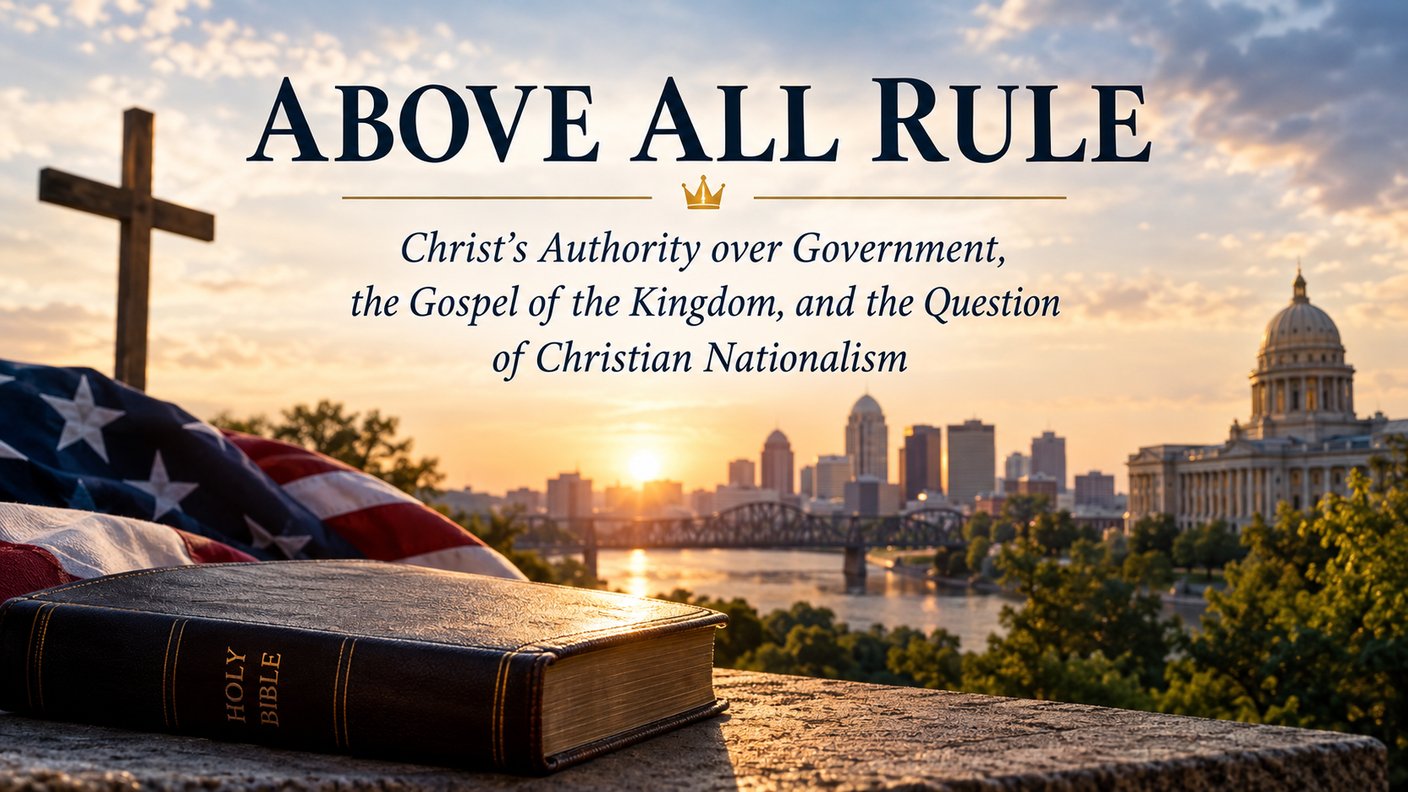
I recently attended a conference in Louisville, Kentucky, titled Above All Rule: Christ’s Authority over Government. The conference explored a question that Christians have wrestled with for centuries: What does it mean for Jesus Christ to possess all authority, not merely over the individual believer or the institutional church, but over the nations, their rulers, and the civil order itself?
The discussions were challenging, thoughtful, and at times sharply divergent. The speakers approached the subject from Baptist, Presbyterian, Reformed, and post-liberal perspectives, examining the historical relationship between church and state, the implications of the New Covenant, the role of civil magistrates, and the contemporary debate surrounding Christian nationalism.
I left with several things to consider, but also with some convictions reinforced. In particular, I believe we need to think more carefully about the relationship between the gospel of the kingdom, the Christian character of a society, and the civil government’s responsibility under the lordship of Jesus Christ.
Christ’s Authority Is Not Limited to the Private Lives of Christians
The conference’s title establishes the central theological question: If Christ is above all rule and authority, what are the implications of that truth for government?
Christ’s lordship is not a metaphor, nor is it a reality confined to the church’s internal affairs. Jesus declared that all authority in heaven and on earth had been given to Him (Matthew 28:18). That declaration precedes the Great Commission, in which He commands His disciples to make disciples of all nations, baptizing them and teaching them to observe everything He commanded.
The scope of Christ’s authority is universal. The question is not whether Christ rules over the nations, but how that authority should be understood and acknowledged in the ordering of human society.
The conference explored several answers to that question. Some speakers emphasized the distinction between the church’s spiritual mission and the state’s temporal responsibilities. Others argued that the church is a transnational community whose authority and public witness cannot be reduced to national identity or the priorities of the modern state. Still others examined the historical Reformed understanding that civil magistrates have positive responsibilities toward religion, including removing impediments to worship and, in some formulations, supporting the public practice of Christianity.
These distinctions matter. The church is not the state, and the state is not the church. The state cannot regenerate a heart, forgive sins, or mediate eternal life. Those are not functions of civil government.
But it does not follow that civil government is religiously neutral, that public life should be insulated from biblical morality, or that Christ’s authority has no meaningful implications for civil law.
A government necessarily operates according to some understanding of justice, human nature, moral obligation, and the common good. The question is whether those commitments will be informed by the truth of God’s revelation or by competing accounts of morality and human flourishing.
There is no genuinely neutral position on these questions. The disagreement concerns which moral framework should govern public life and how that framework should be expressed through civil authority.
The Gospel Is the Gospel of the Kingdom, Not Merely Personal Salvation
One of the most important distinctions we must recover is the difference between saying that the gospel includes personal salvation and saying that the gospel is exclusively about personal salvation.
Personal salvation is indispensable. We are sinners who need reconciliation with God through Jesus Christ. No discussion of the kingdom can diminish the necessity of repentance, faith, forgiveness, justification, and regeneration.
But the biblical gospel is larger than the individual experience of conversion.
Jesus proclaimed the gospel of the kingdom. He announced the arrival of God’s reign, called people to repentance, taught His disciples how to live under His authority, and commissioned them to disciple the nations. The apostles proclaimed Christ crucified and risen, but they also announced His enthronement, His present reign, and His coming judgment of the world.
Consider the Lord’s Prayer:
“Thy kingdom come. Thy will be done in earth, as it is in heaven.” (Matthew 6:10, KJV)
This is not merely a prayer for individuals to experience personal salvation. It is a prayer that God’s reign would be manifested, that His will would be done on earth, and that earthly life would increasingly conform to heavenly realities.
Consider the Great Commission. Jesus does not command His disciples merely to seek individual conversions and leave the nations’ collective life untouched. He commands them to make disciples of all nations and to teach those disciples to observe everything He has commanded.
The nations are within the scope of the commission. So is obedience to Christ’s teaching.
This does not mean that every aspect of the Great Commission is a direct mandate for civil legislation. The church makes disciples through the proclamation of the gospel, baptism, teaching, and discipleship—not through the coercive power of the state. Nevertheless, the commission gives us no warrant to restrict Christ’s claims to the private sphere.
The gospel announces a King. It announces a kingdom. And it calls people, communities, and ultimately the nations to reckon with His authority.
If our understanding of the gospel terminates at the salvation of isolated individuals, we risk losing the biblical vision of Christ’s comprehensive reign. Personal salvation is essential, but it is not the entire horizon of the kingdom.
Next week: how what we expect of the future shapes what we think Christians should be doing in the present.
Above All Rule — part 1 of 7:
- The Authority That Does Not Stop at the Church Door (you are here)
Later parts in this series have not been published yet. They will appear here as they are released.