

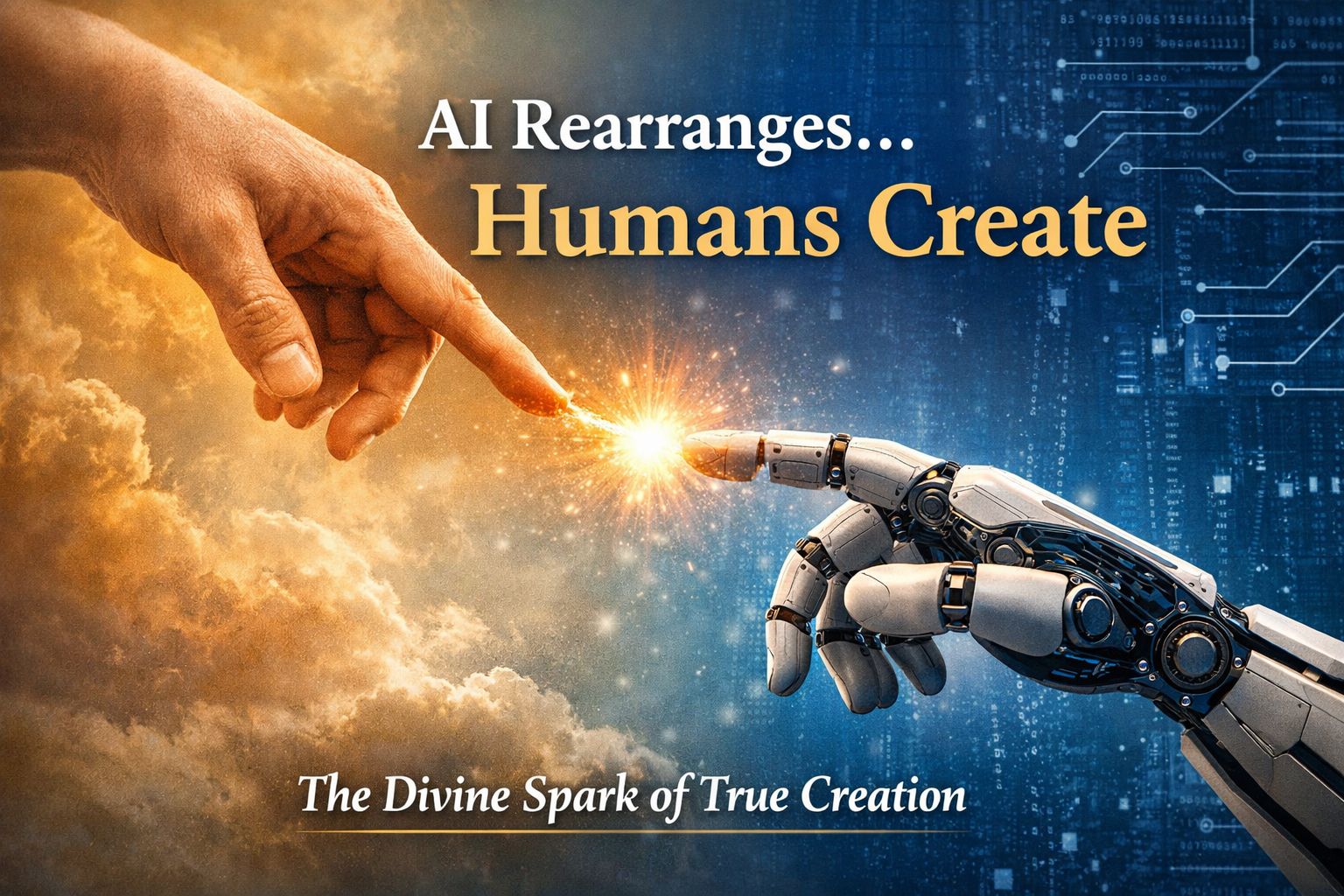
The more time I spend working with AI, the more convinced I become of something unexpected:
AI hasn’t diminished my sense of God—it’s sharpened it.
On the surface, AI looks like creation. It writes, designs, reasons, composes, and builds at speeds that feel almost supernatural. Spend enough time with it, especially at scale, and it’s easy to feel like you’re witnessing a new kind of intelligence being born.
But the deeper you go, the clearer the boundary becomes.
AI does not create ex nihilo.
It cannot add a single new truth to the universe.
Everything it produces is a rearrangement—an interpolation—of what already exists inside its box. That box may be enormous, unimaginably dense, and statistically powerful, but it is still a closed system. AI cannot step outside it. It cannot originate. It cannot will something new into being.
That limitation is not a bug.
It’s the point.
The Creative Spark Is Not Mechanical
Human creativity is categorically different.
When a human creates—truly creates—something enters the world that did not exist before. A new story. A new idea. A new frame. A new question. A new way of seeing. Not a remix, not a probabilistic continuation, but a leap.
That leap is not computable.
You can measure output, but you can’t derive origin. You can analyze form, but you can’t reverse-engineer meaning. The spark itself doesn’t come from data; it comes from being.
And that spark is not evenly distributed, programmable, or predictable. It’s messy, emotional, intuitive, and sometimes irrational. It shows up in art, in science, in faith, in love, and in the moments when someone sees the world differently and refuses to accept the existing shape of things.
AI can amplify that spark.
It can execute on it.
It can scale it.
But it cannot generate it.
Image Bearers in a World of Tools
Scripture says we are made in the image of God. That phrase gets flattened sometimes into morality or reason or authority. But at its core, God is a creator. Creation is not something He does—it’s part of who He is.
To create is divine.
And if we carry even the faintest echo of that image, then it makes sense that humans can do something machines never will: originate meaning.
We can imagine futures that have never existed.
We can choose values that aren’t implied by data.
We can create stories that reshape reality rather than merely describing it.
AI can optimize within a universe.
Humans can redefine the universe they’re optimizing for.
That difference matters.
Why AI Will Always Need Us
AI cannot transcend itself.
It cannot decide to want something new.
It cannot assign purpose where none exists.
It has no internal “ought.”
No vision.
No calling.
It waits.
And that waiting is not weakness—it’s design. AI is a tool of astonishing power precisely because it lacks agency, desire, and origin. It is a mirror, not a source.
The fear that AI will replace humanity misunderstands both AI and humanity.
What AI exposes is not our replaceability, but our uniqueness.
The more capable our tools become, the clearer it is that the thing they orbit—the human creative will—is not reducible to computation.
A Grain of Sand and an Infinite Ocean
If God is the ultimate creative force in the universe, then humans possess only a grain of that power. And yet look at what we’ve built. Languages. Cultures. Cities. Music. Mathematics. Machines that can reason but not dream.
That grain is enough to shape history.
AI is one of the most profound tools ever created, but it will never cross the line from execution to origin. It cannot add to itself. It cannot will itself forward. It cannot create meaning.
Only humans can do that.
And if that capacity points anywhere, it points upward.
Not to our greatness—but to the source of the spark itself.
Creation Reveals the Creator
AI doesn’t make God obsolete.
It makes Him obvious.
It draws a bright, unmistakable line between intelligence and creativity, between power and purpose, between simulation and soul.
We are not becoming less human by building these systems.
We are discovering, more clearly than ever, what it means to be human at all.
And in that discovery, I see God—not threatened, not replaced, but reflected.