

Two weeks into February, most of our developers had already consumed 85% of their monthly premium request quota for agentic code generation.
Not because we were behind.
Because we were moving too fast.
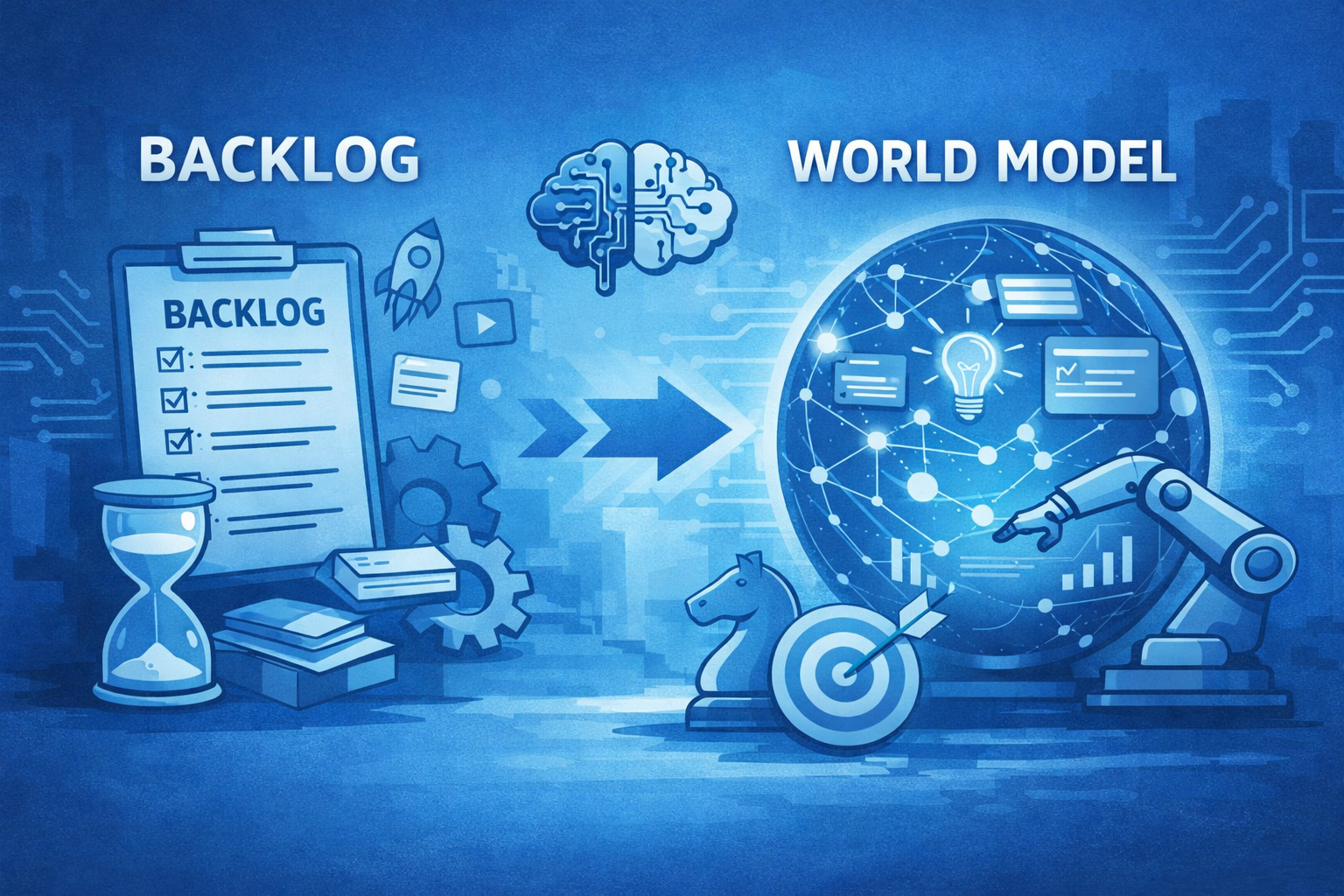
By the halfway mark, it was clear: our backlog would never behave the way it used to.
Backlogs have long been the backbone of software planning — a way to prioritize work when development speed was slower than demand. But agentic AI is rewriting that rulebook. Features that once took weeks can now be prototyped in hours. Tasks that used to feel meaningful now feel like “change the button text.”
The bottleneck is no longer development speed. It’s decision-making and validation. Teams are shifting from incremental feature delivery to rapidly building production-ready POCs, testing ideas, and validating business viability before committing to full-scale releases.
This feels reminiscent of other disruptive technological shifts in history.
The Steam Engine → Industrial Revolution: Mechanization made labor no longer the limiting factor. Supply exceeded old organizational structures, forcing logistics, coordination, and market discovery to become the bottleneck.
Assembly Line → Ford’s Manufacturing Revolution: Production speed soared, but inventory, quality control, and demand forecasting became the critical constraints.
Agentic AI in software development is having a similar effect. Delivery speed is no longer the constraint. Human judgment, strategic prioritization, and risk management are now the bottlenecks.
But there’s a limit. Large language models are remarkable pattern predictors, but they are stateless and constrained in reasoning. Persistent world understanding — tracking multi-step causal relationships, long-term dependencies, and system-wide effects — will require the next evolution: World Models.
Think of it like the transition from the steam engine to the internal combustion engine. LLMs are the steam engine: powerful but limited. World Models + AI agents are the internal combustion engine: integrated, stateful, and capable of sustained, strategic impact.
The future is coming fast. Backlogs as we know them may vanish, replaced by experiment queues, rapid POCs, and decision-driven pipelines. Development velocity will no longer define productivity; the value of human guidance, validation, and business judgment will.
Software development is entering a new era — one where speed is trivial, and strategy is everything.