

Months ago, I wrote two posts—Stop Writing Code and Stop Writing Code: Reality.
The reaction was about what I expected. A lot of engineers pushed back hard. Some said I was missing the point. Others said it was irresponsible. Looking back, that criticism was fair. Those posts were pointing at a direction, not showing evidence of one.
This is the evidence.
Inside Acuity Inc., we stopped arguing about it and started running experiments.
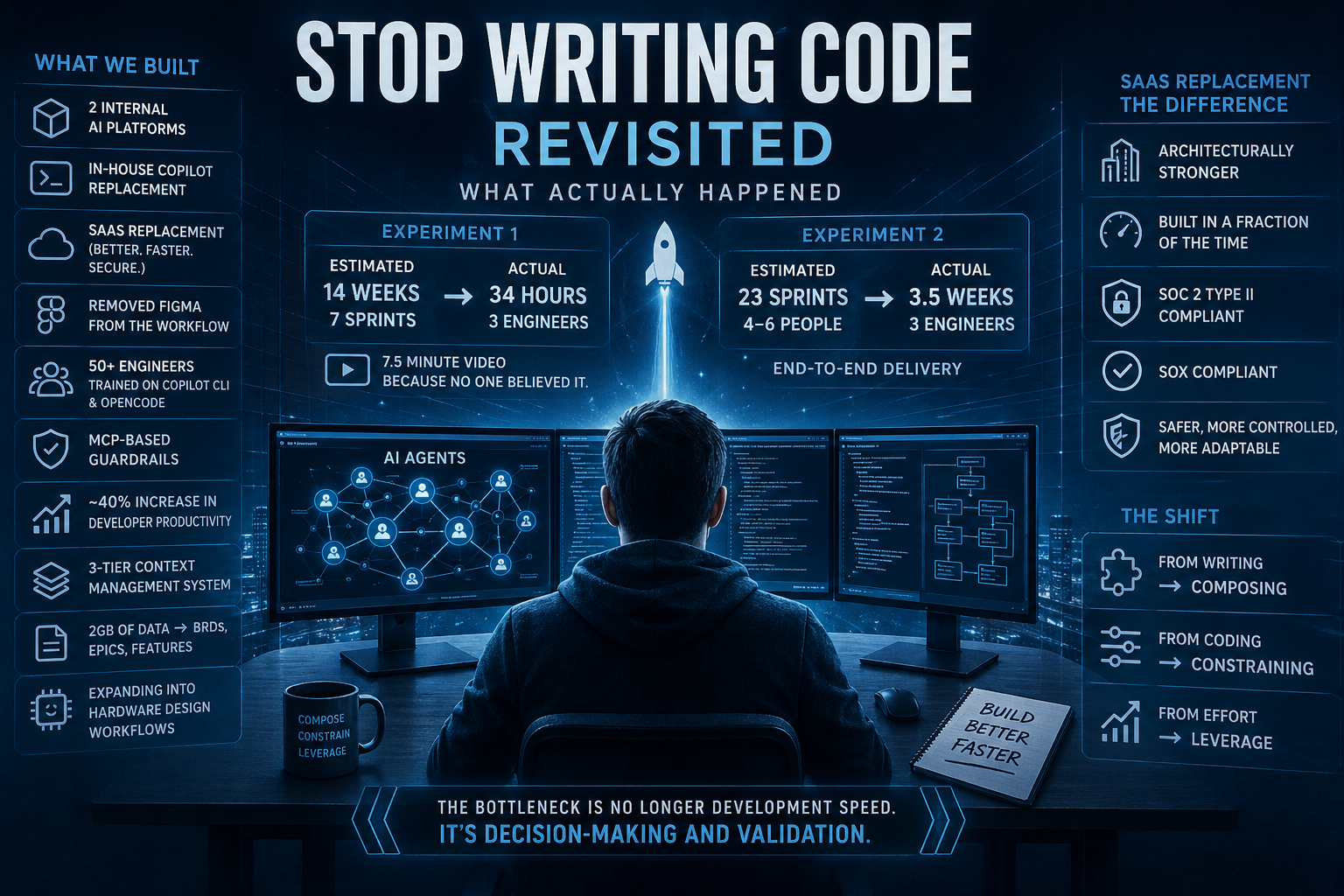
The first one: a project originally estimated at 14 weeks across multiple engineers. Three engineers finished it in 34 wall-clock hours. We recorded it—a 7.5-minute video—because when we told people, they didn’t believe us. That video changed the internal conversation.
The second: a 23-sprint project scoped for 4–6 cross-functional team members. Three engineers delivered it end-to-end in 3.5 weeks. Not a prototype. Not a demo. Shipped.
Those results didn’t just feel good—they created pressure to build infrastructure around them. So we did:
- Two internal AI platforms for agent orchestration
- An in-house replacement for Copilot
- A full SaaS replacement
- Removal of UX mockups from the workflow
- Agentic tooling and workflow training for 50+ engineers
- Spec-driven, skill & MCP-based guardrails for constraining agent behavior
- A measured ~40% increase in developer productivity
- A three-tier context management system
- Product workflows that process ~2GB of unstructured data into structured delivery artifacts
- Early extensions into hardware design workflows
The SaaS replacement is where it gets harder to dismiss. It wasn’t just faster to build—it came out architecturally stronger than what we’d have produced manually under normal constraints. SOC 2 Type II compliant. SOX compliant. More controlled and more adaptable than the system it replaced. Built in a fraction of the time.
The uncomfortable part: what came out of that process exceeded what our best architects likely would have produced under the same constraints. Not because the people were different. Because the method was.
When I said “stop writing code,” people read elimination. That wasn’t the right frame. What’s actually shifting is where the effort goes—less time manually constructing systems, more time defining constraints, shaping architecture, and orchestrating outcomes. Engineers aren’t going away. But what it means to do good engineering work is changing, and it’s changing fast.
Most of the debate circled around whether AI replaces engineers. That question keeps missing the point. The more interesting one: what happens when engineers are no longer bottlenecked by how fast they can type?
Because we’re seeing the answer. Fourteen-week projects in 34 hours. Twenty-three-sprint roadmaps compressed into weeks. Internal tooling replacing commercial SaaS. Architecture emerging faster than traditional design cycles allow.
This isn’t a better version of the old model. It’s a different one.
If you were part of that earlier conversation, I’d go back and reread those posts—not because they were right about everything, but because the direction they described is now backed by actual delivery.
The shift is already underway. Writing is becoming composition. Coding is becoming constraint definition. Effort is becoming leverage.
You don’t have to agree with any of that. But you’re already competing with teams, like mine, who’ve made the switch.
At this point, the burden of proof has flipped.
It’s no longer on people like me to prove this works—it’s on others to explain why they’re not seeing it.